Posts

Quality Matters Certified

Ah, good news. My general education course, ENGL 160D: Nonhuman Subjects: Monsters, Ghosts, Aliens, and Others , has now been designated as meeting Quality Matters Internal Review Standards for online course design excellence. I don't get nothing for it, but it's a nice little perk. The designation is also a total bear to get -- besides doing a two-week online training earlier this summer on how to apply the QM rubric, the rubric is just a bastard to actually apply. There's 42 criteria, many of them involving "aligning" your course content with course-level and module-level Student Learning Outcomes, and much of it is admin-centered rather than student-centered. (That is, students never care or read these SLOs, but they're useful from an admin perspective.) If you miss even one of the essential criteria, you have to revise the course. Luckily, despite a 25-page review document, I only missed one of the 42 criteria, so revision wasn't that bad. All in all, ...

Update on the Cockatrice Colophon

Image
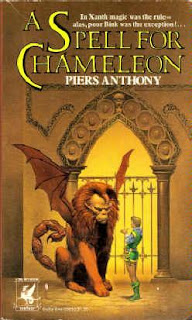
 A few weeks ago, I posted a lengthy blog entry on the mysterious colophon implanted by the Del Reys onto their new line of Ballantine fantasy books in 1977. Thanks to reading Anthony's  A Spell for Chameleon,  I thought the colophon a basilisk at first but after consulting with Douglas Anderson, we concluded that it was probably a  cockatrice ...  which I found interesting because Doug, apparently, had always heard the symbol referred to as a griffin, even though griffins aren't two-legged critters. Anyway, after some more digging, I found a few other tidbits. In Piers Anthony's second autobiography, How Precious Was That While,  I found the following passage (p. 134): So, one of the unanswered questions from my original post was, "Why did Lester del Rey apply his signature colophon to certain fantasy novels but not others?" The answer, apparently, turns out to be spite . After checking Donaldson's book covers on the ISFDB, Anthony's story check...

New Publication on H. P. Lovecraft in SUPERNATURAL STUDIES

My latest open-access publication: " The Hesitation Principle in 'The Rats in the Walls, " in Supernatural Studies . This was originally a section I cut from my article on the same Lovecraft story (forthcoming in Gothic Studies,  due March 2021). Only started revising this piece after GS accepted the main article , but Supernatural Studies was so amazingly quick with peer review and publication -- basically, five weeks overall -- that it's actually appearing a good half-year before my Gothic Studies article. Just one of the quirks of academic publishing. On a personal note, this is officially my 10th peer-reviewed publication .... though five more are forthcoming. Just nice to finally hit double-digits, though.

Reflections on Terry Goodkind

Image
So, I meant to do this post several weeks ago, after I'd read Stone of Tears and posting about several Goodkind interviews . Then this nutty semester happened, and of course Goodkind himself passed way on September 17th. Yet, now, I'd like to complete about my thoughts .... particularly on Goodkind's  Sword of Truth series, but focused on the one novel ( Stone of Tears ) I read. Violence So ... yeah.  Damn,  there's violence galore. Even ignoring the few hundred pages of sex-torture that Richard survives in Wizard's First Rule , Goodkind apparent reserved a special store of gruesomeness  for  Stone of Tears : more torture, cannibalism (albeit by good guys, the Mud People), characters being flayed alive, gang rape (p. 414), threats of gang rape, genocide .... Goodkind runs the gauntlet of awful things that human beings can do to one another. None of it evokes much real horror, apart perhaps from one character who is flayed alive. Either Goodkind doesn't have the ...

Cockatrice Colophon!!

Image
NB: see  Update on the Cockatrice Colophon  for more on this subject. ------------------------------------------------------------------------------------ So, during my re-read of Piers Anthony's A Spell for Chameleon , I noticed the odd little colophon in the book's corner. It's pretty clearly aping the famous Unicorn's Head colophon from the Ballantine Adult Fantasy Series, and it's signaling the new fantasy line started by Lester de Rey (i.e., Ballantine/Del Rey) in 1977. The question, though, is "What the hell kind of critter is this?" For a while, I was thinking basilisk. That's mostly because of  A Spell for Chameleon, which features a basilisk -- a rare enough creature in fantasy that I thought Anthony's book might have actually inspired the colophon. (Similarly, I suspect that Peter S. Beagle's The Last Unicorn inspired the Unicorn's Head colophon, but there's no knowing for sure.) Then I asked Douglas Anderson , who's prett...

Piers Anthony, his "Author's Notes," and a Sad Story

Reposted from my social media : In my early teens, I read a lot of Piers Anthony. For fantasy fans of my age group, most of us did.  A Spell for Chameleon was the first "adult" novel I ever read, and I would have been 11 or so at the time. Even by the time I outgrew his novels a few years later, though, I retained a lingering affection for the "Author's Notes" that would conclude most of his books. They were, for the most part, honest and chatty commentaries on Anthony's own life, and I enjoyed them. Sometimes, since he mostly just discussed his life in these Author's Notes, he would occasionally mention his daughters. The oldest, Penny, was about a decade older than me. I then forgot all about Piers Anthony and his books for 20-some years, until very recently, when I was browsing through his biography, I saw that his daughter Penny had died in 2009 from complications from skin cancer. Anthony himself remained alive and well, which means that he had si...

Piers Anthony and A Spell for Chameleon

So, I started getting tired of reading critical theory for my book proposal, so, almost by accident, I started writing something about A Spell for Chameleon and the different possible ways of reading a text. (I'm viewing this as a reflection on our habits of reading, both through "innocent" or "reparative" readings against critical readings.)  Browsing through the commentary on Anthony, though, and there's a lot of overviews and summaries and so forth. Plus, I saw a few book chapters, mostly from the 1980s, one peer-reviewed article from 1975 in the then-nascent  Science Fiction Studies , and even one short introductory book by Michael R. Collins from 1983. Judging from what I've been reading, I suspect that Anthony -- particularly as his reputation has shifted over the last five decades -- might have been rated higher as an author had he *never* written a Xanth novel. Or even, perhaps, had he even stopped at only one or two. Some of this early commenta...