The Mysterious Case of Adam Corby; or, Two Great 1980s Fantasy Editors at Work
NB: this post first appeared on my Substack (September 8, 2026)
If you’ve never heard of Adam Corby, the 1980s fantasy author who wrote The Former King (1981) and The Divine Queen (1982), well, don’t worry too much – nobody else has heard of him, either.
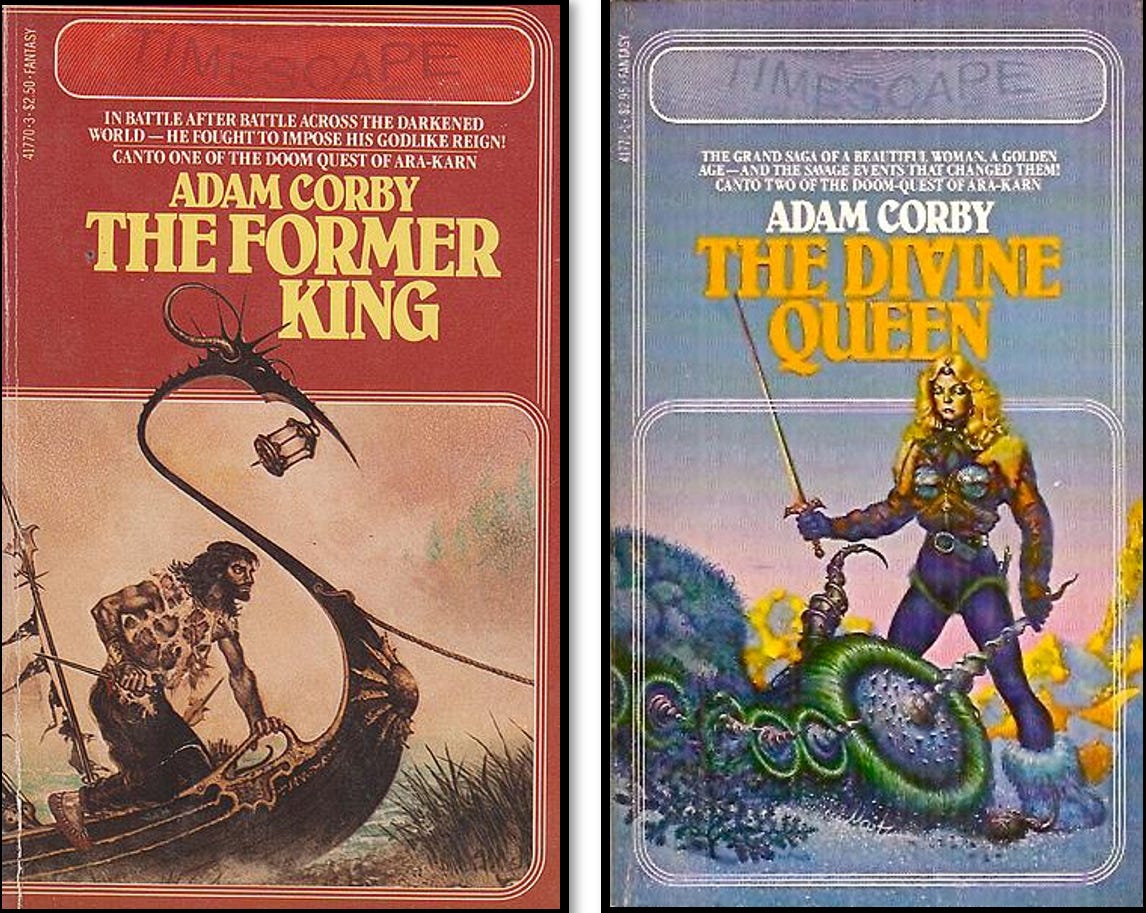
But if you take a moment, the Corby case demonstrates how two major fantasy editors from the 1980s, Lester del Rey and David G. Hartwell, each a polar opposite in terms of editorial vision, approached the nascent fantasy genre.
For me, the mystery began about two years ago. While reading Stephen R. Donaldson’s unpublished correspondence with ole’ Lester, I came across a passage where Lester started harrumphing about the demands on his time. Among the various time-sucks, he mentions the following:
Then I get a novel [from the slush pile] that’s 35 percent brilliant, 65 percent disaster--and I spend an extraordinary amount of time by letter and in person trying to get it rewritten. (Eventually, the writer felt that he had to preserve his precious ‘message’ --in category fiction--and dare not listen to other ideas. So that was wasted work.) More lost time. [Date: July 3, 1979]
Unfortunately, there are no other details. No name; no title; nada. So I shrugged and moved on.
Fast forward two years.
While browsing one archive, I happened upon an unpublished interview between David Bischoff and Judy-Lynn del Rey, the true animating force behind Del Rey Books. Bischoff intended this interview as the third installment for his SFWA Bulletin series on editors, but for some reason it never saw print. Anywho, during this interview, Judy-Lynn casually mentions during that her husband just read a manuscript from someone named Stephen Pond, and Lester hasn’t been so “excited about a writer since he discovered Donaldson.”
Ah-ha, I thought. Since Del Rey never published anyone by that name, and since the timeline checks out, I knew Lester’s mystery author must be Pond. Unfortunately, the ISFDB doesn’t list any “Stephen Pond,” anywhere, so this seemed like another dead-end until I turned literally just one more page and saw that Bischoff helpfully provided the name for Pond’s manuscript: Doomquest of ARA-KARN.

Two seconds later of furious googling, I figured things out. Pond published his manuscript with Timescape under the pseudonym “Adam Corby.” Although I still haven’t fully confirmed Pond’s real-life identity, I suspect he’s the same fella who co-wrote an action-packed academic textbook called Introductory Dynamical Oceanography (1978). If Corby was a pre-tenure oceanographer writing random fantasy novels, that could explain the fake name. (Plus, just as an aside, an oceanographer named “Pond” is one of the all-time great professor names!)
Mystery solved!
There’s more, of course. Notably, Lester not only considered the Pond/Corby manuscript one-third brilliant, two-thirds disaster, but also thought that Corby had the potential to rank alongside Stephen R. Donaldson, the main prestige author in Lester del Rey’s fantasy line.
Rather than working through Lester’s editorial suggestions, though Corby decided to take his manuscript elsewhere. At Timescape, Hartwell snatched it up with only one required change. (More on that later.)
By looking at The Doom-Quest of Ara-Karn, then, we can compare two radically different editorial strategies by two of the genre’s greatest editors, David Hartwell and Lester del Rey.
Yet doing so requires a little “speculative criticism.” Problem is, I don’t have either Lester’s letters or Corby’s original manuscript. Maybe neither even survives. So our only sources are two novels by Timescape; one brief author’s note Corby added to a self-published sequel almost thirty years later; Lester’s epistolary aside to Donaldson; and everything I know about Lester’s and Hartwell’s editorial philosophies.
Let’s begin.
Corby’s Timescape Novels
First things first.
In his author’s note to Darkbridge (2009), the self-published fourth volume of The Doom-Quest of Ara-Karn, Corby briefly describes his tetralogy’s publication history. He doesn’t mention Lester (or his own real name), but he does reveal David Hartwell’s single requirement: break the manuscript down into a trilogy. That makes sense, too. Publishers generally hate long novels by debut authors, so Timescape needed some way to mitigate the financial risk. And Corby obliged. As he writes:
At the time I considered this to be a mistake: personally I love and prefer long tales, if they be good ones, and enjoy the prospect of a good long read when I heft a thick tome in my hand. But I agreed to David’s condition of publication because he knew his business, and I also saw opportunities for improving the tale by restructuring some chapters in the course of helping each volume to stand better on its own.
So far, so good. The Former King (1981) only needed a little reworking. The Divine Queen (1982) needed more, but still no problem. After that, things went off the rails for Corby.
For one thing, Hartwell was fired in 1983. That turned Doom-Quest—plus many other Timescape series—into orphans. Even worse, Corby lost control of his story. The narrative had “run away from me,” he explains. The page count ballooned out of control; he needed ages to finish; and neither The Former King nor The Divine Queen had sold well. Thus the new editorial team had every reason for rejecting Corby’s manuscript, which they did, and the thing sat in a desk drawer for decades until the rise of self-publishing allowed Corby to concluding his tale with The Iron Gate and Darkbridge as ebooks in 2009.
Why did Hartwell like The Doom-Quest of Ara-Karn, though? I suspect that three specific, outstanding virtues caught his eye. (Remember, without direct evidence, this is all speculative, but I’m pretty familiar with Hartwell’s tastes, so this seems solid.)
(1) Style
As an editor who took pride in maintaing literary values, Hartwell had a fetish for good prose, and Corby’s a beautiful stylist. The conclusion of The Former King, for example, presents an absolutely brutal and visceral account of the barbarians’ sacking of the city of Gerso. Likewise, The Divine Queen contains passage after beautiful passage, yet all without disturbing the pacing. Grade A+.
(2) Medievalism & Classicism
In terms of world-building, Corby knows literary history well – a feat even doubly impressive considering that his day job was (probably) physical oceanography. But when writing about his northern barbarians, Corby flaunts his immersion in Beowulf, not to mention Tacitus.
When Ara-Karn first appears, he does so on a “death-barge”: a homage to Sheild Sheafson. Likewise, women in Germanic cultures had relatively high status. In Beowulf, Queen Wealhtheow gives her husband, Hrothgar, political advice, which he takes, and similarly in The Former King Chieftain Gundoen’s wife exerts a large sway over her husband. Other well-known aspects of Germanic cultures, for instance blood feuds, appear as well.
Granted, Corby does pull a few switch-a-roos. For one thing, his barbarians wear armor, and outside the mythical (i.e, non-historical) case of Sheild Sheafson, most Germanic peoples interred their dead in barrows. The whole “Viking funeral” thing is a myth. But one of the affordances of fantasy is that authors can change, add, or mix historical sources as they like, and Hartwell, who held a PhD in medieval literature, certainly recognized everything Corby was doing.
Corby continues the smarts with The Divine Queen. Structurally, this empire is basically Roman (plus they’re under assault by barbarians!), but the culture is mostly classical Greek.
As one further indication of Corby’s willingness to mix-and-match historical analogues: Ara-Karn himself seems partly modelled on Atilla the Hun. That’s an Asiatic rather than Germanic influence, obviously, but at one point a character dubs Ara-Karn the “scourge of God,” and one important plot point involves Ara-Karn teaching the barbarians a new technology: bows & arrows. This is one reason they conquer the empire so quickly; it doesn’t seem to have missile weapons or artillery of any sort. Notably, neither Greek hoplites nor Roman legions used bows.
(3) Existential themes.
One complaint raised by Lester concerns Corby’s devotion to his “message.” Obviously, Hartwell was less finicky. But what was Corby’s message? Well, he seems to have loved himself a hearty dose of existentialism.
In Jean-Paul Sartre’s classic slogan, the core tenet of existential philosophy is “existence precedes essence.” There are no objective meanings or ontological givens that guide our actions: only our own free will. Over-arching principles like right, wrong, justice, morality, God: they proceed from our own choices, nothing prior, so we can’t in good faith attribute our deeds to such things. Only to ourselves.
In Corby, the enigma that is Ara-Karn gets at the heart of this matter. Is he mortal? Is he divine? Nobody can really decide. His background is completely mysterious. Readers get various hints that Ara-Karn is maybe the reincarnation of some ancient, mythic king who was betrayed. Also that a lost lover was maybe involved somehow. But even after The Divine Queen, his enigma continues.
Various dialogues reinforce Corby’s existential roulette. During the sack of Gerso in The Former King, for example, Ara-Karn murders a priestess in cold blood, which horrifies his barbarian allies, but he also refuses to punish – against all custom or reason – a would-be assassin. One character, aghast, questions Ara-Karn whether letting the boy go was the “right” thing to do. Ara-Karn’s response? “It is what I have done” (FK p. 224).
Even better is another dialogue from The Divine Queen. Here, Empress Allissál is having a serious conversation with her secret lover, who, unbeknownst to her, is actually Ara-Karn. (Long story.) First, Allissál chides him for seeming to believe in fate or doom. Then the following exchange occurs:
“Oh?” she asked, thinking him to be acting a madcap for her entertainment. “And where does your doom lie, may I ask?”
“Well, for that,” he said with a smile, “I haven’t decided yet.”
“Ah—and are you God now as well?”
He looked at her, and there was no humor in him. “When was I not?”
“You speak madness,” she said, angry and alarmed. “What is human will then, if all is predestined?”
“Will is that which creates our destinies in the first instance.” (DQ 124).
Ara-karn chooses his own destiny … and his own death, too, apparently. Total free will. Hartwell, perhaps recalling John Gardner’s existential-themed Grendel (1971), undoubtedly loved it.
Lester Del Rey
Considering all these virtues, then, why did Lester consider two-thirds of Corby’s original manuscript a “disaster”?
Well, here’s the thing with ole’ Lester. Although he didn’t absolutely avoid manuscripts with good prose, deep literary learning, or messages, he did consider all deeply suspect. Only literary critics and academics cared about such things. Real readers cared about story. Thus, for a mass-market genre like fantasy, if either prose, messages, or literariness harmed the core narrative in any way, Lester’s editorial wrath knew no bounds.
That’s what I think happened with Corby.
The bulk of Lester’s editing, you see, usually involves “plot doctoring”. He diagnosed the various narrative ills suffered by sickly young manuscripts. His core principle derives from agent Scott Meredith’s famous “plot skeleton”: a likeable hero has a problem, but every effort by the hero to solve that problem only makes the problem worse until, eventually, the hero succeeds, decisively but logically, by virtue of their own efforts.
In one way or another, this plot skeleton explain most major plot problems unwittingly created by their authors.
So let’s take The Former King, whose 200 pages most closely resemble the original manuscript seen by Lester.
As mentioned, Corby presents Ara-Karn as an enigma, an existential force of nature without explanation or higher justification. This is central to Corby’s theme. At the same time, tons of plot stuff happens in the book. Despite arriving alone and friendless, Ara-Karn rises to become overlord of the north, King of the Barbarians, and even makes his first attack upon the Empire. Every scene in The Former King thereby shows the progression of those events, step by step, and Corby wisely doesn’t waste much time on interior monologues or explicit philosophizing.
Unfortunately, these events don’t actually constitute a plot. Not really; not least according to Meredith’s plot skeleton.
To see the problem, let’s examine our main protagonist, Ara-Karn. Although not technically a “likeable hero”— arrogant and supercilious are better adjectives—he’s what we got. What actual problem must Ara-Karn solve, though? The answer isn’t “become King of the Barbarians,” because that’s not actually a problem for him, per se. Ara-Karn has no real motivations, that we see. Does he want power? Wealth? A sense of belonging? Nothing seems right. He seeks kingship, but we never know why.
Worse, nothing substantive hangs upon the outcome of Ara-Karn attaining kingship. Whether he succeeds or fails, nothing hangs in the balance. Even if he wants kingships—and Corby, remember, deliberately refuses to tell us—there is no must there. That limits the reader’s own engagement. Why care about the novel’s outcome, when failure means so little?
In fact, readers aren’t even sure whether overthrowing the empire – the clear “next step” after attaining kingship – is worthwhile. Maybe it’s one of those good, nice empires that appear so often within genre fantasy. Plus, the empire certainly doesn’t seem to oppress the barbarians in any way. It most ignores them, in fact. The main reasons the barbarians want to attack, reiterated several times, is partly because the empire’s men are “soft” and its women are eminently rapeable. (Yes, unfortunately, those are the reason several tribesmen offer.) So reading The Former King is like watching a sporting event that you don’t care about. The winner doesn’t really matter.
Furthermore, Corby’s first novel isn’t even really a novel. It’s more like a prologue. A certain air of inevitability pervades The Former King. Even if nothing substantial hangs in the balance, readers still know how things will turn out. Ara-Karn will win. Thematically, one can recognize that Corby’s playing with the Germanic concept of wyrd, which he renders as “doom-quest.” But such inevitability collides against Meredith’s plot skeleton. In this model, we expect things to get progressively worse for the hero. In contrast, Ara-Karn never suffers any setback. He leaps every hurdle with ease (i.e., no narrative tension), and we never doubt his eventual success. Readers wade through 200 pages of material, and their only reward is a conclusion telegraphed from page one.
These problems, I believe, are what Lester recognized. In literary terms, Corby needed to render Ara-Karn as a wyrd-marked enigma for his existentialist theme, but, in the process, he undercut every possibility for narrative tension. He never permits readers to wonder, “What happens next?” We already know.
Ironically, Corby’s second novel, The Divine Queen, succeeds brilliantly at the Meredith plot skeleton. Our heroine, Allissál, is thoroughly likeable. She also has a major problem: Ara-Karn’s arm is invading her empire, and unless she stops them, the consequences for her will be tragic. Every effort she undertakes to solve her problem, however, only makes the problem worse. And readers knows why. Allissál’s lover, Ennius, is actually Ara-Karn in secret. As it happens, Corby handles this “double-agent” aspect so skillfully that I couldn’t put The Divine Queen down. Honestly, I absolutely loved this novel. As proof, I stayed up two hours past my bedtime just to finish it.
But as Lester recognized, most readers would never reach the Allissál part of the story. Nobody wants to wade through 200 pages of prologue, no matter how well it sets up later events.
Lester being Lester, I’m sure he explained all these issues to Corby at length. Yet Corby recognized that fixing Ara-Karn’s character and rewriting The Former King would radically alter the enigmatic quality he considered central to his manuscript’s theme. So Corby walked away … and found Hartwell.
The Commercial Failure of Doom-Quest
There we have it: my best reconstruction of what two different fantasy editors from the 1980s, David G. Hartwell and Lester del Rey, made of The Doom-Quest of Ara-Karn. But now the key question. Who served the manuscript better?
It’s a tough question. Honestly, nobody really knows why one book sells and another doesn’t. Publishing has all sorts of apocryphal lore, but really, everything’s just guesswork. At the same, Lester was obviously a better “guesser” than Hartwell, so I think we can safely touch upon a few strong reasons for why Timescape did so miserably with Doom-Quest.
First, obviously, is that Lester knew what he was talking about. The narrative flaws in Corby’s manuscript really did negatively impact the story. A 200-page prologue in mass-market fiction is a commercial death sentence. Although The Former King isn’t dull or uninteresting, its literarly virtues are so niche that only an editorial idealist like Hartwell could possibly believe they compensated for such a hurdle.
Still, books sales are always multi-causal. If Timescape had marketed Corby’s books more effectively, perhaps The Doom-Quest of Ara-Karn could have overcome its structural issues. Sadly, Hartwell committed three further mistakes that probably doomed Corby’s novel for good.
Mistake #1: That hideous cover
I mean, just look at this sucker:
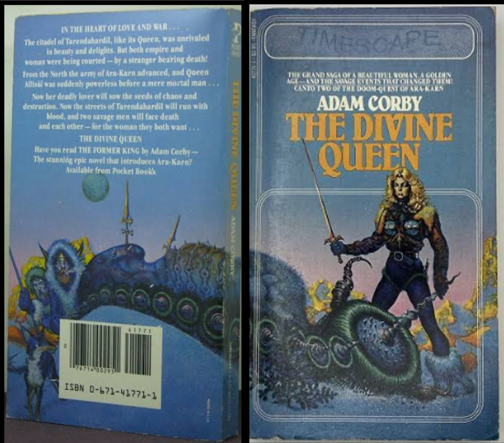
What the bleep is that? Never in my life have I seen anything so hideous. The painting fails on every aesthetic level, but it also fails to convey any sense of the novel. That’s supposed to be Allissál on the front, I guess, but she’s not some sword-wielding Avenger of God figure. She’s the essence of pampered divine femininity in a decadent, late Roman-esque empire. And what is she standing over? It looks vaguely like a broken chariot wheel with a spike, but nothing like that happens in the story.
If anything, the back cover is worse. Again, no idea about the object’s identity, but the blue people with horns perplex me. Given their furs, I suspect artist Don Maitz was attempting to represent the barbarians, but Corby’s barbarians are conquerors, not befuddled miniature Eskimos. Also, I wonder if he made them blue because … they’re cold? Who knows.
The true pity, though, is that wrap-around covers usually signal that publishers have put resources behind a title. After all, wrap-arounds are expensive. Hartwell clearly believed in The Divine Queen, but his chosen cover did Corby no favors.
Mistake #2: No map.
Granted, maps aren’t always required. One of my favorite fantasists, Glen Cook, never uses them, and Terry Goodkind achieved great commercial success without. But Lester certainly believed fantasy novels sold better with maps, and a map would have been useful for Corby’s books, especially The Divine Queen. So, this seems like a missed opportunity.
Mistake #3: The sequel problem.
This final issue, I believe, is pure editorial oversight. The Divine Queen is a brilliant novel, but sequels always suffer from readers who haven’t read the first book. This issue particularly affects The Divine Queen because so much depends on readers realizing early that “Ennius” is really Ara-Karn undercover.
Let me give one example. Soon after forming her relationship with “Ennius”, Allissál decides to surprise him. Since a refugee from Gerso, the town sacked by Ara-Karn, had just recently arrived at the capital, she thinks to surprise her lover by making an introduction. Maybe they knew each other!
As it happens, they did. The refugee is none other than Ara-karn’s would-be assassin from The Former King, the youth whom he released without punishment. If anyone could blow Ara-karn’s undercover identity, it’s this kid. He has spoken vows of vengeance. To fulfill them, all he’s gottado is speak.
Despite those vows, however, the boy says nothing, and Corby handles this episode with finesse and impeccable narrative logic. Unfortunately, all that skill goes to waste for anyone unfamiliar with The Former King. Within the first 200 pages, Corby’s sequel only provides one narrative clue about Ennius’s true identity. It’s enough for anyone who’s read The Former King, but only for them. Otherwise, newbies might realize something seems off about Ennius, and they certainly recognize that the kid’s terrified of him, but they won’t know why or realize just how much danger Ennius is in. Such readers thus miss have the novel’s narrative tension.
Traditionally, the sequel problem has two solutions. The most common involves the author inserting just enough narrative exposition that first-time readers can catch up. That wouldn’t work for The Divine Queen; minimal exposition is one of Corby’s stylistic virtues. So that leaves the second option: adding a “What Has Gone Before” section at the beginning.
Nothing like that appears in The Divine Queen.
As editor, Hartwell should have recognized the problem. He didn’t. Corby’s sequel thus went out into the wide world with a terrible cover, no map, and an inferior experience for anyone who hadn’t read The Former King. Say what you will about Lester or Judy-Lynn, but they always made the reader’s experience their foremost priority. Every book they published, they believed, had the potential to be the first – or last – SFF novel ever encountered by its reader.
So at day’s end, I think the Mysterious Case of Adam Corby is an object lesson in “what if.” Nobody can deny his skills or talent. So I wonder: what if Corby had followed Lester del Rey’s suggestions for revision? What if Del Rey Books, not Timescape, had been the publisher who marketed The Doom-Quest of Ara-Karn?
Perhaps the final product would have differed substantially from what Corby originally envisioned … but also, maybe, the fantasy genre would have had another major fantasy author whose novels we still read today.


Comments
Post a Comment