Posts

Editorial Interview

Back in February, the MOSF Journal of Science Fiction issued a call for applications for editor positions, and I put my name in, of course. My term with Fafnir ended back in December, and it was time for the next step. Well, we just had the interview this morning. It went well; the editor-in-chief (they oddly call him a "managing editor") seemed like a really cool fella, and it was good hearing about the journal. Granted, I've done my own background research on MOSF JOSF , and the interviewers confirmed my impression -- they've had a lot of editorial turnover these last few years, and the journal itself is probably even in a more precarious state than Fafnir was when I first came aboard. Well, challenges and all that. The interviewers will make their decision in about a week; we'll see how that goes.
Biographical tidbits on John Heath-Stubbs

So, I've been writing an article on John Heath-Stubbs, the British poets, who's of interest to Tolkienists because he studied at Oxford in the early 1940s and wrote one epic poem, Artorius , with major sections in the alliterative meter. (Everybody knows that Auden admired Tolkien's use of Old English poetics, but Artorius is actually much better than The Age of Anxiety .) Anyway, I had the brilliant idea to look up some biographies of JHS's acquaintances in the hopes of gathering some more biographical detail on JHS himself. I found three relevant books, of which the third is the most interesting. (1) Eddie's Own Aquarius , edited by Constance Short ad Tony Carroll. This is mostly about Eddie Linden, the Irish-Scots poet who ran the magazine Aquarius for over three decades. He was close friends with JHS, though, and there's one reminisce by Robin Prising where he states that he knew nothing of JHS except his Blue-Fly poems, so Eddie took him "off to the Ca...

Advertising our Department's Majors

Welp -- so, I just sent out over 100 200 emails (!) to non-majors who took our Gen. Ed classes last year, inviting them, "Hey! We're cool! Get a second major with us!" Already had two nibbles of interest, and we'll see how this works out. This isn't the first time we've tried this sort of direct advertising before, but this is larger scale than anything we've previously done. Our department actually has three separate majors -- English literature, Creative Writing, and Professional & Technical Writing -- and tons of bells and whistles: scholarships, study abroad, newsletters, publications, and so forth. We have a lot going for us, honestly, but of course the English major has been on a precipitous decline for well over a decade. So let's see if this direct advertising is brilliant, or merely desperate.

Grading Marathon

Image
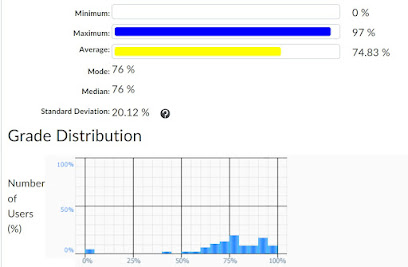
Ay yai yai! So I just graded 50 five-page essays for my 373A class in less than 30 hours, and the students will be getting them back during their very next class period. These quick turnaround always mattered to me as a student and as an academic, so I hate dawdling. Overall, I composed nearly 13,000 words of individual feedback, which is about 260 words per student. The last two days were intense, but at least they're done. Just in case anyone is interested, here are the "general" comments I offered to the class on D2L afterward. They very much align with how I try to present myself as an instructor: ------------------------- Hey everyone, So, final essays have been graded, and we have a pretty decent range overall. As you can see from the class statistics below, the average grade was a C (75%). The most common grade was C+ (75-79), and the next most common grade was A (90-94). A few people absolutely knocked it out of the park altogether. I gave everyone substanti...

Response to a "Values Statement" Draft

I don't often talk about writing pedagogy here, but given that most of my teaching is for Writing Program classes, and that my professionalization is continually ongoing, I've obviously developed many, many views on the theory and practice of writing, especially in Writing Programs. Anyway, we've recently devised the draft for a "values statement," and it's loaded with words like compassion, autonomy , equity , inclusion , and curiosity . The whole thing made me roll my eyes, and in response to this draft, I presented my objections to the entire statement in the following manner ----------------------- So .... I'll be honest. I absolutely hate this statement. The bolded words [ compassion, autonomy ,  equity ,  inclusion , and  curiosity]  are a simple list of abstract-noun buzzwords, and although I have no real objections to any word in particular (for example, what rational person would reject autonomy?), that is largely because each buzzword is so vague...

Tolkien Exceptionalism in the Published Scholarship

Recently started reading Amber Lehning's The Map of Wilderland: Ecocritical Reflections on Tolkien's Myth of Wilderness  (2022), and while I'm not far along enough in the book to offer a final opinion, I did get stopped in my tracks by one early remark in particular:  Had he written nothing else, " Beowulf : The Monsters and the Critics" would have been enough to rank Tolkien among the great critical thinkers of Western literature. (8) It's hard to believe that no one, nowhere, in the entire  production process, caught this truly wince-worthy hagiographic exaggeration. Of course, Tolkien's essay undoubtedly is the single most famous essay ever composed on Beowulf , but still ..... "great critical thinkers"?  Tolkien was a brilliant philologist, to be sure, but even among medievalists there's a lot of competition for the spot of top dog. When you branch that out to great "critical" thinkers of all Western literature, that makes me qu...

Tolkien would have struggled as a modern academic

Yeah, this maybe will be a weird post, coming from a Tolkien scholar. Still, reflecting more on John M. Bowers's excellent Tolkien's Lost Chaucer (2019), I realize that Tolkien would have struggled badly as a modern academic ... and that I, most likely, would have resented him deeply as a colleague.  Not as a person , mind you; Tolkien's a decent enough fellow. But my feelings are very much the product of academic labor under the modern neoliberal university. Thousands upon thousands of academics in various states of precarity: contingent laborers who, despite exceedingly high competence in every area of academic labor (research, teaching, and administration), and despite no research support, poor wages, and stressful labor conditions, nevertheless toil in precarity while certain excessively privileged faculty (certain tenure-trackers, Ivy Leaguers, etc.) muddy along with at best middling competence. Don't get me wrong -- as a philologist, Tolkien was brilliant, and he ...